
I found particularly interesting the section “Productivity in the age of hypergrowth” and its subsection “More engineers, more problems” of the book An Elegant Puzzle by Will Larson [1]. These sections describe the amount of theoretical productivity of a three engineers team that is experiencing hypergrowth. It is assumed that one trained engineer spends about 10 hours a week for each untrained engineer. The author goes ahead calculating the total amount of “productive” time, meaning the time not spent on hiring or training or on-call activities, considering a scenario where there are about 2 untrained engineers for each trained engineer.
The concepts are illustrated with graphs showing the number of trained/untrained engineers in time, but I felt that a visual representation of the weekly hours of the trained engineer was missing, so I produced the following image myself:
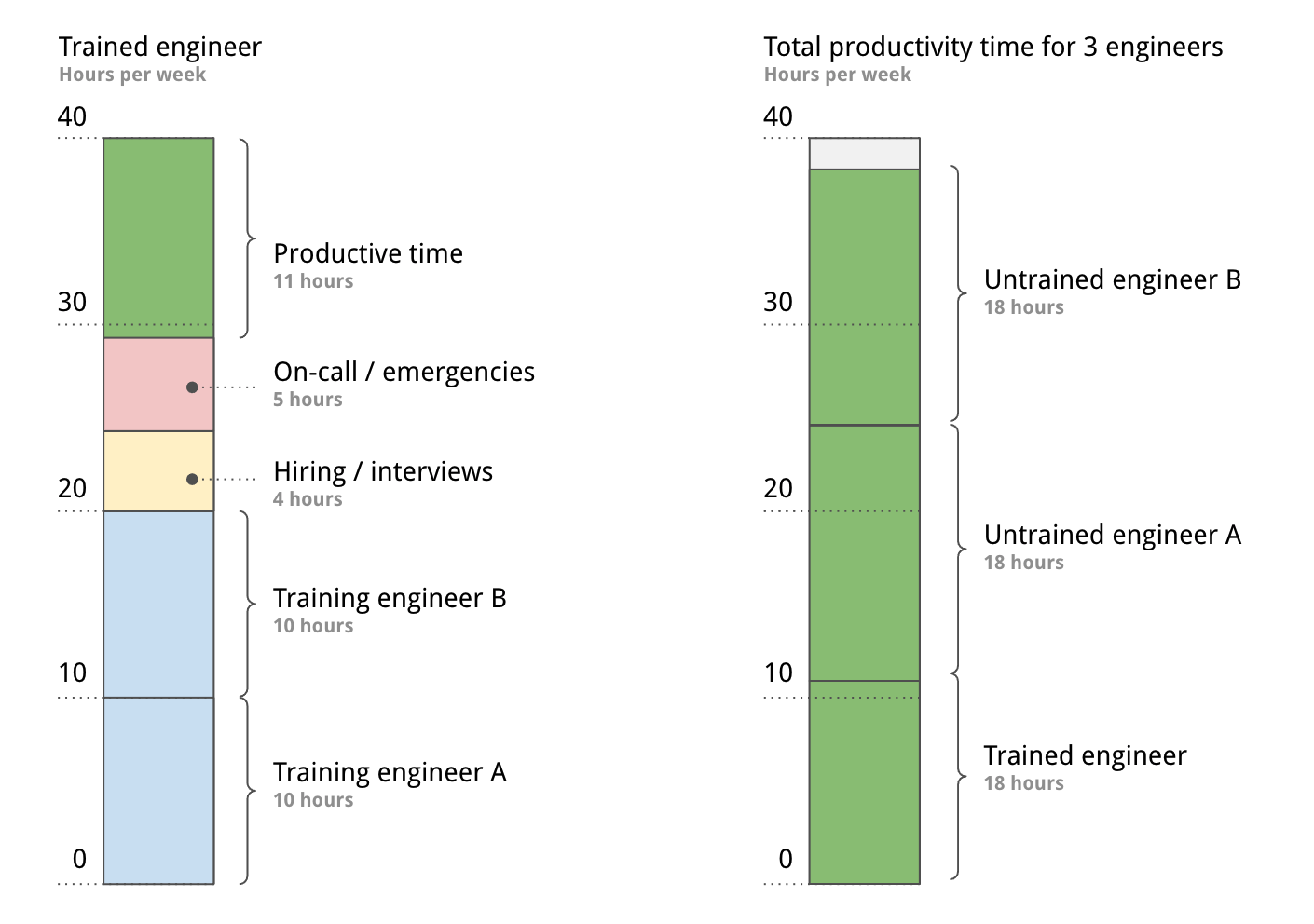
A trained engineer spends about 20 hours training the 2 untrained engineers. On top of that, she spends about 4 hours on hiring and interviewing activities and 5 hours addressing on-call and responding to emergencies.
As quoted from the book:
“[…]your team overall is now getting less than the output of a single trained engineer for every three engineers you’ve hired.”
With 20 hours spent on training and 9 hours between interviews and on-call activities, the trained engineer has only 11 hours remaining to dedicate to everything else. The untrained engineers are not part of the on-call rota as they have not been trained yet and they also cannot actively run interviews yet. Assuming that the two untrained engineers are about 1/3 of their time productive or 13 hours per week per engineer, the total time of “productivity” is 11 + 13 x 2 = 37 hours.
Interestingly, the overall productivity for the 3 engineers is about 37 hours per week, which is less than the output of a single trained engineer. Also interesting to note that the untrained engineer output (~13 hours per week) is higher than the one of the trained engineer (~11 hours per week).
[1] An Elegant Puzzle
Systems of Engineering Management
 Bernardino Frola